
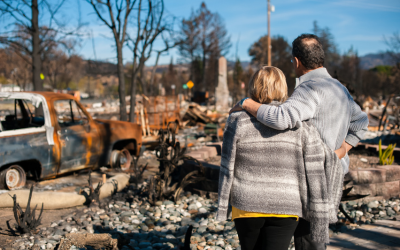
Practical Approaches to Mental Health in Crisis and Disaster Response
Year: 2026 | Competency/Strategic Skill: Leadership and Systems Thinking | Priority Topic: Mental Health | Setting: Online | Format: On-Demand | Sponsor: Emory University/Central Office
Overview:
This is a 90-minute recording of a live webinar on May 12, 2026.
Natural disasters and large-scale crises don’t just disrupt systems. They reshape how individuals, communities, and organizations experience safety, connection, and meaning. This training explores how behavioral health professionals, educators, and leaders can respond with intention by integrating self-care, trauma-informed care,
Participants will examine how crises impact mental health across multiple levels, from individual stress responses to organizational strain and community-wide disruption. Through a human-centered lens, this session emphasizes expanding perspective: understanding not only what is happening, but how it is experienced differently across cultures, identities, and roles.
Using practical frameworks and reflective exercises, participants will strengthen their ability to remain grounded, responsive, and effective in high-pressure environments, while also recognizing that how we care for ourselves directly impacts how we care for others, even in crises.
Presenter:
Lamarr Lewis, LAPC, is a dedicated public servant, mental wellness advocate, published author, and change agent. As a community-based practitioner, he has worked with such diverse groups as; individuals living with psychiatric disabilities, people in recovery, At-Hope (He does not use the term At-Risk) youth, and more. He tirelessly gives back to his community through homeless outreach initiatives, public speaking, mentoring, coaching, and finding ways to develop the next generation of leaders. He is an alumnus of Wittenberg University in Springfield, Ohio, and received his master’s degree from Argosy University in Clinical Mental Health Counseling. He is currently a mental health therapist, trainer, and consultant. His lifelong mission is to leave the world better than when he found it.
Learning Objectives: By the end of this webinar, participants will be able to:
- Explain the principles of trauma-informed care, cultural humility, and systems thinking as they relate to mental health responses during natural disasters and crises.
- Analyze how individual experiences of crisis are shaped by cultural context, systemic factors, and environmental stressors across community and organizational levels.
- Apply at least two strategies for integrating self-care and trauma-informed, culturally responsive approaches into their professional role during crisis response.
CERTIFICATE: The course contains two modules: a module to access the webinar and an evaluation module. After accessing these modules, learners will earn a certificate of completion.
This project is supported by the Health Resources and Services Administration (HRSA) of the U.S. Department of Health and Human Services (HHS) under grant number UB6HP31680, Public Health Training Centers for $4,348,992. This information or content and conclusions are those of the author and should not be construed as the official position or policy of, nor should any endorsements be inferred by HRSA, HHS or the U.S. Government.